
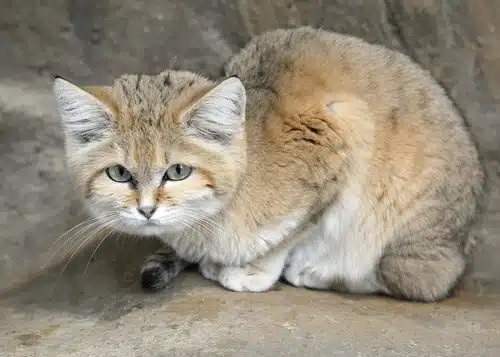
If you’re a cat lover, the Sahara sand cat might have made it into your feed. Not that you can have one as a pet, mind you. Though these wild cats are super cute, they’re a little bit like Persian cats…
Why?
Well, like Persian cats, they like things to stay the way they are. Your Persian hates it when you move their favourite armchair to the other side of the room. Likewise, the Sahara cat wants to keep it’s wild heart intact and unchanged. So it’s staying put in the wilds and not venturing to your lap.
But there’s nothing stopping you from ogling these adorable desert felines online. Which is why, we’ve rounded up some juicy sand cat facts, here:
In this article
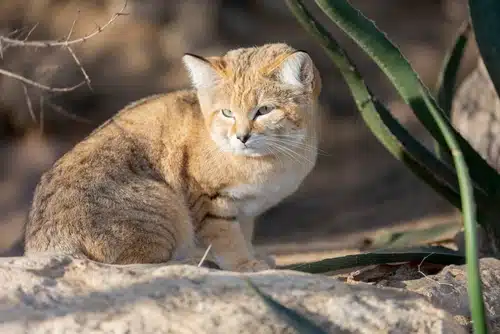
1. Can you have a Sahara sand cat as a pet?
As mentioned, these furry felines are wild at heart and can’t be domesticated. It seems sand cats branched away from our domestic cat’s ancestor millions of years ago. Speaking of cat ancestors – check out how domestic cats came to exist.
In the desert, not the house
Sand cats live in the deserts across the north of Africa, through the Arabian Peninsula, Middle East and Central Asia. Cats generally aren’t big on hydrating (one reason dry cat food sometimes isn’t as healthy as wet food) and sand cats exemplify this by living far from water.
Their kingdom is the sand and stony desert region, where they can snack on rodents, snakes and birds.
Basically, Sahara sand cats like the desert. People who’ve tried owning them as pets tend to have found they suffer from respiratory infections when they’re moved away. So again, not exactly pet material.
If you’re hooked on a cute cat that kind of resembles a wild cat, read about the Bengal cat and the Toyger cat. And on this note, because these are rare breeds, here’s more on finding ethical breeders.
2. Is the Sahara sand cat spotted or striped?
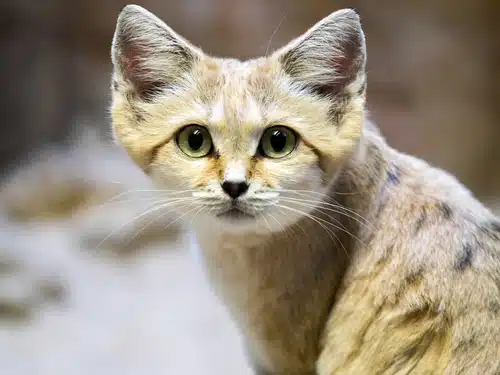
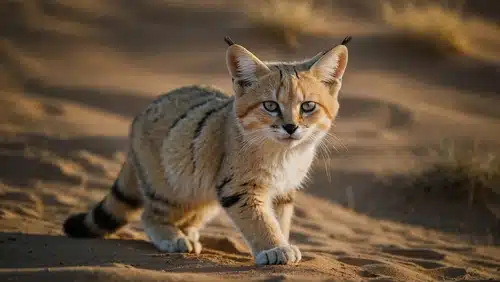
You could say either or, and sometimes both. Sand cats can have soft stripes or spots. They can also have a combination of both and in some cases neither. The common theme in this feline’s outfit is its light sand-coloured fur, yellow-green eyes and a soft red line that runs from corners of its eyes to below its ears.
Cute!
This wild cat has another uniquely fabulous feature: thick fur on the undersides of its paws. Just like you or I might wear thick fluffy slippers this meowser protects its paw pads from soaring heat and plummeting cold by “wearing shoes”.
3. Do sand cats meow?
Yes! Like many different cat breeds, Sahara sand cats meow! In fact, they traverse both cat and dog language because they sometimes even bark! They do this to try attract a mate and we’re not exactly sure whether it’s wholesale the same as barking, but certainly it comes close.
Speaking of speaking the lingo… Have a go at understanding your darling dog or curious cat a bit better with our pet talk guides:
- How to speak dog
- Dog dogs cry?
- Why do dogs bark?
- Cat body language demystified
- How to speak cat and be understood
Check out these cute Sahara cat kittens, caught on film in the wild:
4. What’s special about this cat?
Many things! Besides their gorgeous paws, their soft sandy fur (that grows up to 5cm in winter) and their solo behaviour, there’s another… We all know dogs and cats have supersonic hearing, smelling and sight. But where Sahara sand cats outperform house cats is in the ear department.
Sahara sand cats have normal sized cat ears that are slightly wider and lower set than domestic cats. The inner ear canal is double the size which means these wild cats catch five times more sound – measuring in at 8 decibels more!
Cats are great hunters and the Sahara sand cat has the tools to hear its prey long before they meet on the sand bank. If you’re worried about your house cat catching Australian birds and other wildlife consider a catio for a partial indoor cat lifestyle.
5. Are sand cats dangerous?
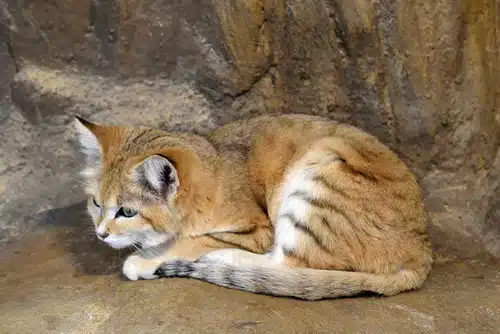
If you’re a lizard, bird or rodent living in the Sahara sand cat’s desert environment you might be out of luck. As a hooman though, you’re almost entirely unlikely ever to meet one in person except at a zoo.
That said, if you somehow were stranded in the deserts of North Africa, Southwest or Central Asia and encountered one, you’d be lucky. The Sahara sand cat likes to lay low and is pretty much solitary. It’s unlikely to do anything but stay hidden from anyone or anything bigger than it.
6. Are sand cats endangered?
The Sahara sand cat is on the Red List of the International Union for Conservation of Nature – but thankfully under ‘Least Concern’. Although it stays safe because of living in such inhospitable environment and spreading across continents there is still concern for its future.
Mainly this is because the places the Sahara sand cat lives are being encroached on by human development. Habitat loss is one of the biggest threats to this little kitten’s longevity.
7. Are Sahara sand cats nocturnal?
Yes, Sahara sand cats are busiest at night. This is when they hunt and since they have great hearing and eyesight it’s no problem. Hunting at night also staves off the danger of getting roasted in the daytime sun.
Rather, these cute wild cats spend their daylight hours snoozing in little burrows they carve out in the sand or even lying on their backs atop the sand. Sometimes they simply choose to nestle in shrubs.
Now that we’ve answered seven questions on the super cute Sahara sand cat, let’s talk about your cat (or dog).
Award winning cat and dog insurance
Domestic cats and dogs get into all kinds of scrapes and pinches. Even though they don’t have to hunt for snakes and other prey like our little Sahara sand cat, they face modern dangers.
These include things like gastro, swallowing poisonous stuff, allergies, accidents and many more. Because vet bills can be so expensive and there’s no free healthcare for pets, pet insurance helps you with unexpected vet bills.
Consider getting a pet insurance plan to help pay for unexpected vet costs so you don’t have to foot the bill alone. Get award winning pet insurance with PD Insurance and you can get one or more months FREE!
Click below to start a quote.